Shopify product title element displays the name of the selected product on your storefront. It’s one of the most important elements in a product page, as it helps customers immediately identify what they are viewing or purchasing.
Purpose
Show Product Name: Displays the title of the current product dynamically.
Improve SEO: Helps search engines understand your product page content.
Maintain Consistency: Ensures the product name matches Shopify’s product database automatically.
I. Product Title Element - Content Settings
1. SEO Settings
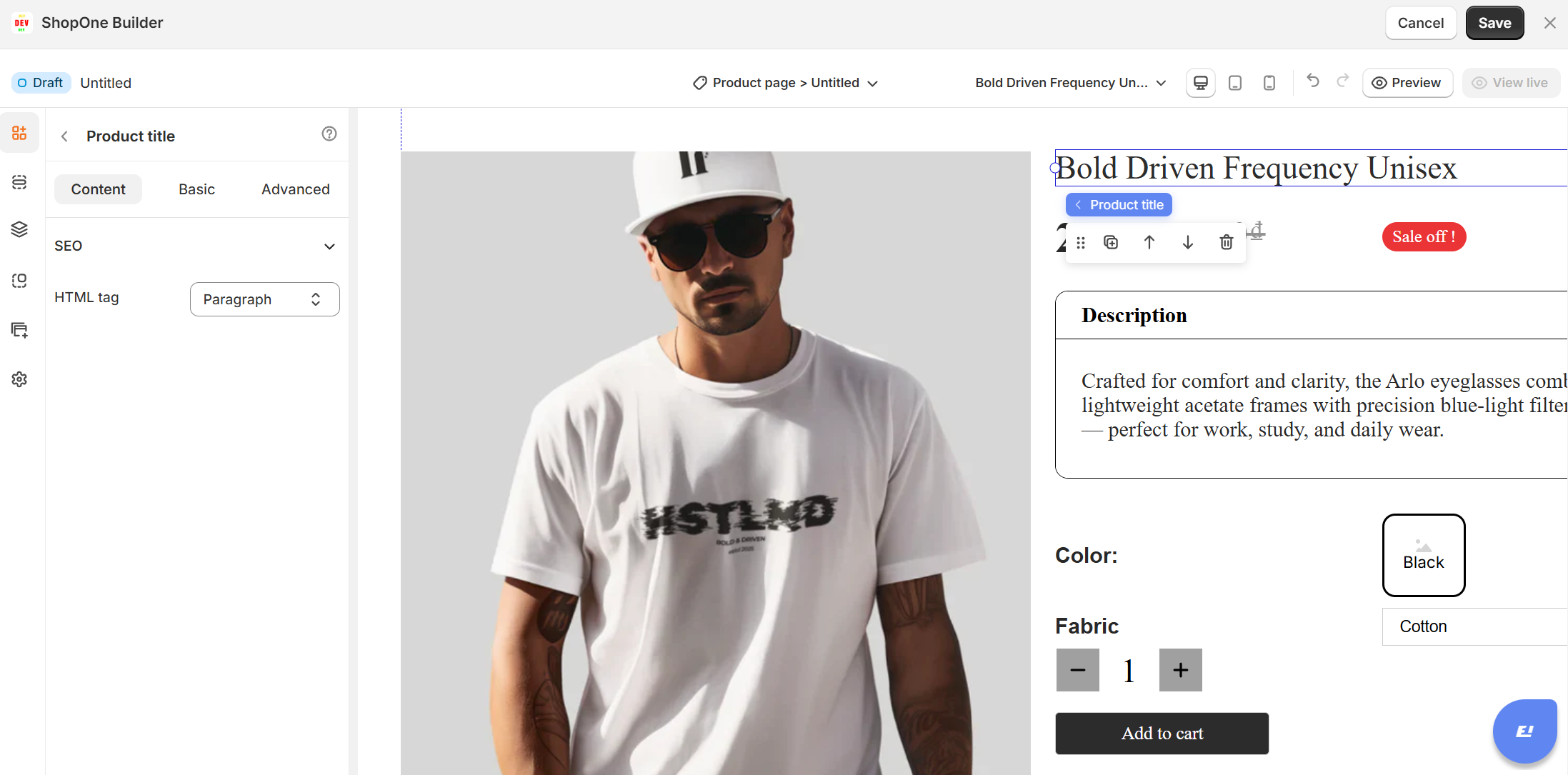
HTML Tag
Choose which HTML tag should wrap the product title for SEO and semantic structure.
Options usually include Heading 1 (H1), Heading 2 (H2), Heading 3 (H3), and Paragraph.
Best Practice: Use H1 for the main product title on a product detail page to help search engines recognize the primary topic of the page.
Use Cases
Product Detail Pages: Display the product name as the main heading.
Collections or Featured Sections: Use a smaller heading or paragraph tag to display multiple product titles in a grid layout.
SEO Optimization: Configure different HTML tags depending on where the element appears on the site (H1 for main product page, H2/H3 in product sliders or related product sections).
II. Product Title Element - Basic Settings
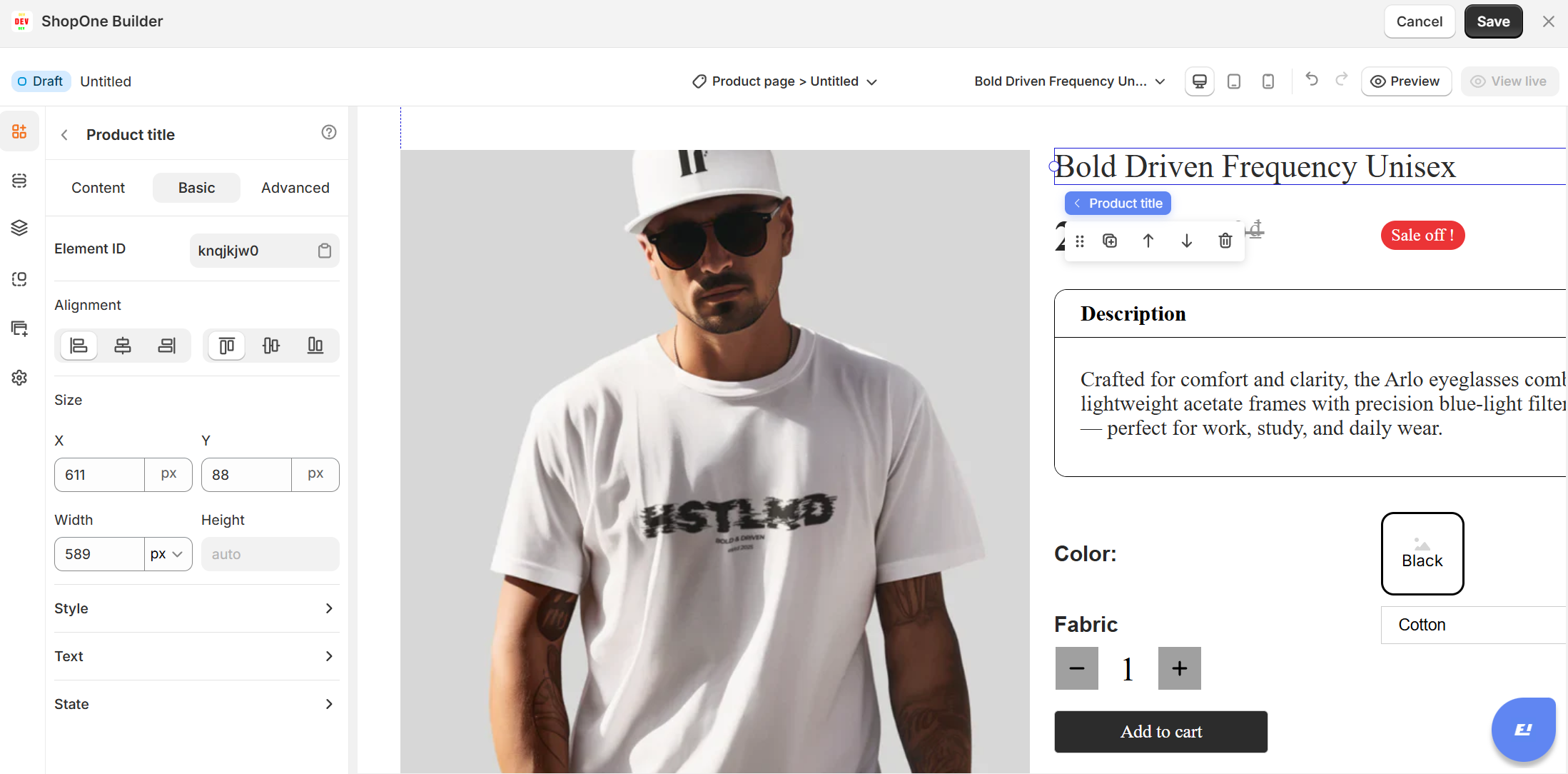
1. Alignment
Align the product title left, center, right, or justified within its container.
2. Size
Adjust width and height manually to control the space the title occupies.
3. Style
Background: Add a background color behind the product title.
Opacity: Control the transparency of the background color (0% = fully transparent, 100% = fully opaque).
4. Customize Text
4.1 Text alignment
- Align your text to the left, center, right, or justify it across the container.
- Helps structure your content according to the design layout.
4.2 Type
- Choose the text type: Paragraph, Heading 1, Heading 2, Heading 3, etc.
- This is useful for creating proper content hierarchy and SEO-friendly headings.
4.3 Font family
- Select from different fonts (e.g., Poppins).
- This changes the overall style and feel of your text.
4.4 Font size
- Adjust the text size in pixels (px).
- Example: Larger size for headings, smaller size for body text.
4.5 Text color
- Change the text color using the color picker.
- You can match it with your brand colors or background design.
4.6 Font weight
Adjust how bold or light your text appears (e.g., 400 = normal, 700 = bold).
4.7 Font style
- Choose between default, italic, or oblique text styling.
4.8 Line height
- Control the spacing between lines of text.
- A higher value increases readability, especially for longer paragraphs.
4.9 Letter spacing
- Adjust the space between individual letters.
- Useful for creating a clean, modern, or dramatic look.
4.10 Text decoration
Add styling such as:
- Underline (U)
- Strikethrough (S)
- Overline (‾)
4.11 Text transform
Change text case automatically:
- Default – keeps original typing
- Uppercase – converts all letters to caps
- Lowercase – converts all letters to lowercase
- Capitalize – capitalizes the first letter of each word
4.12 Text shadow
Add a shadow effect behind the text.
Can make text stand out more against the background.
5. State (Normal & Hover)
Configure different text colors for normal display and hover state to improve interactivity.
Use Cases
Product Page Heading: Use as a large H1 heading to make the product name the most prominent text on the page.
Collection Grid Item: Display multiple product titles in smaller font sizes within a product listing grid.
Custom Styling: Add background color or hover effects to create a unique product card design.
III. Product Title Element – Advanced Settings
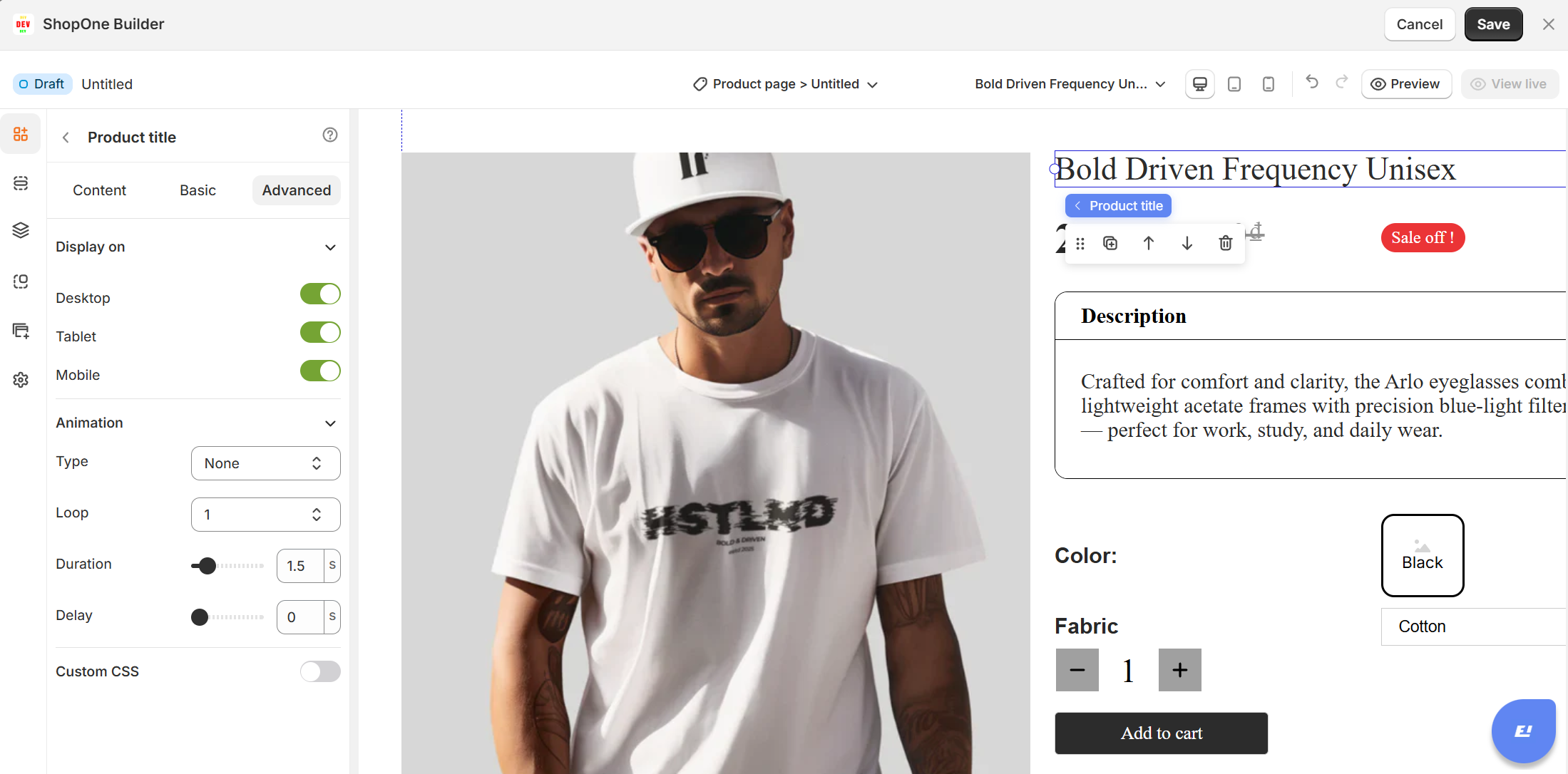
1. Display On
Control where the image is visible:
- Desktop: Show or hide the image on desktop devices.
- Mobile: Show or hide the image on mobile devices.
2. Animation
Add visual effects when the image appears on the page:
- Type: Choose from available animations (fade, slide, zoom, etc.).
- Loop: Number of times the animation should repeat.
- Duration: How long the animation lasts (in seconds).
- Delay: Time before the animation starts (in seconds).
3. Custom CSS
Apply custom styling for advanced design control:
- Class Name: Add a CSS class that you can reference in your stylesheet.
- Custom Style: Write inline CSS styles that apply only to this image element.
Thanks for reading! If you have any questions, please contact us via email: support@shopone.io
Was this article helpful?
That’s Great!
Thank you for your feedback
Sorry! We couldn't be helpful
Thank you for your feedback
Feedback sent
We appreciate your effort and will try to fix the article
